
The Future of Pharmaceutical Procurement in Nigeria
Why the Way Pharmacies Buy Medicines Is Changing

Abdulwahab Olúfọlábòmí Sanuth
12th march, 2026
PharmaceuticalSupply ChainNigeriaDigital Health
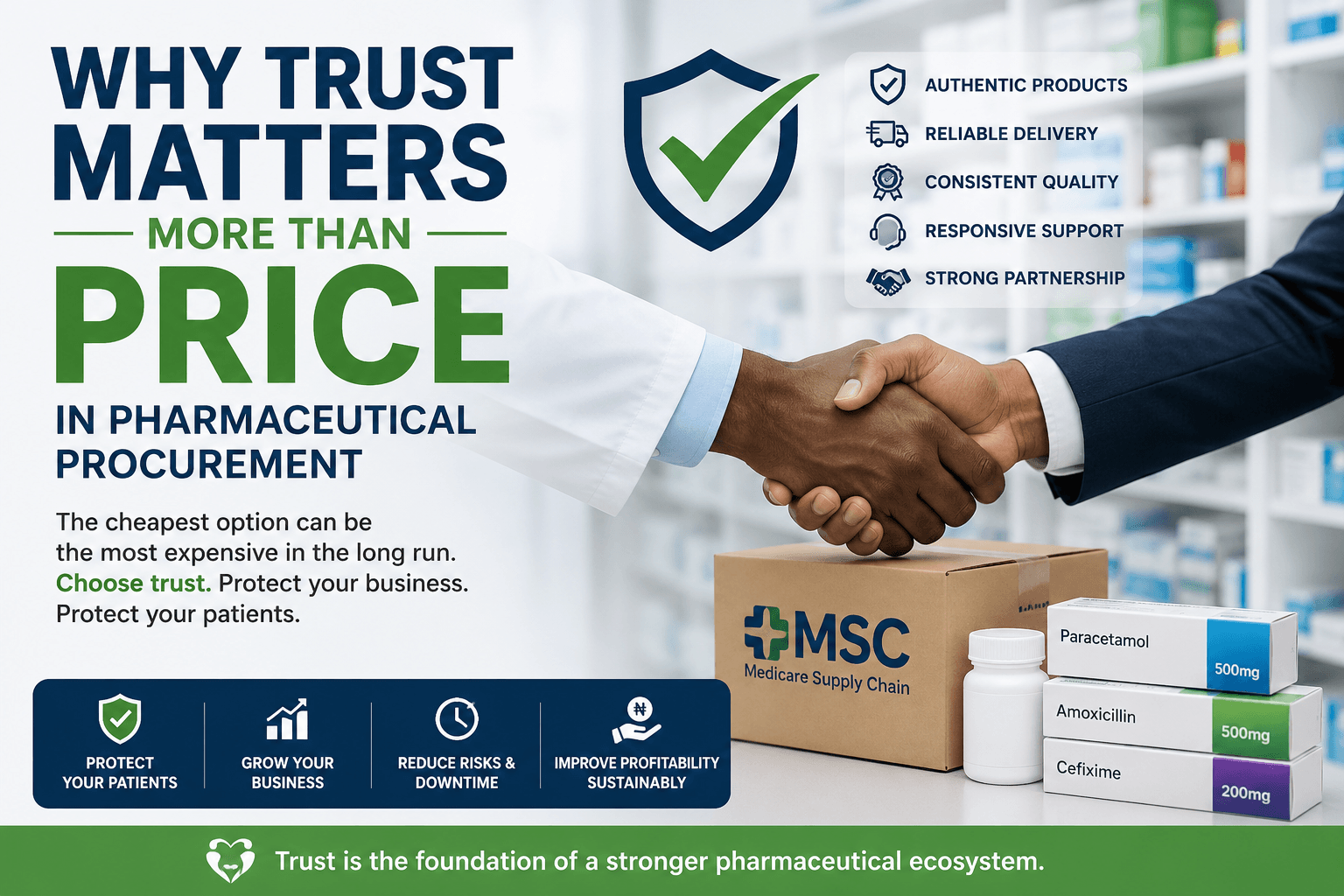
Pricing dominates procurement conversations. But when pharmacies talk about their most important supplier relationships, the conversation rarely begins with price.
Every pharmacy wants competitive pricing.
Lower procurement costs can improve margins, increase profitability, and create room for business growth. It is therefore understandable why pricing often dominates procurement conversations.
Yet when pharmacies discuss their most important supplier relationships, the conversation rarely begins with price.
It begins with trust.
Can the supplier consistently deliver?
Will the products arrive on time?
Are the medicines genuine?
Will the order contain what was requested?
Can problems be resolved quickly if something goes wrong?
These questions influence procurement decisions every day across Nigeria's pharmaceutical ecosystem.
While price matters, trust often determines where pharmacies ultimately choose to buy.
When a pharmacy purchases an item at a slightly higher price from a trusted supplier, the additional cost is visible.
What is less visible are the costs associated with an unreliable supplier.
A delayed delivery can result in:
An incorrect order can create operational disruptions and additional costs.
A counterfeit or substandard product can have far more serious consequences, affecting patient safety, business reputation, and regulatory compliance.
In these situations, the cheapest supplier often becomes the most expensive option.
Unlike many other industries, pharmaceutical procurement directly affects health outcomes.
Pharmacies are not simply purchasing inventory. They are sourcing products that patients depend on.
The importance of trust becomes clearer when viewed against the challenges facing the wider pharmaceutical sector.
According to NAFDAC, more than 50% of Certificates of Pharmaceutical Products (CPPs) submitted for imported medicines were found to be fake, highlighting the scale of verification challenges within pharmaceutical supply chains. (Nairametrics)
For pharmacies, this means supplier credibility and product verification are no longer administrative concerns. They are essential risk-management requirements.
As a result, procurement decisions are often influenced by factors such as:
These factors create confidence that extends beyond individual transactions.
Over time, trust becomes part of the supplier's value proposition.
Our market surveys revealed that many pharmacies continue to rely heavily on long-standing supplier relationships.
In many cases, pharmacies work with suppliers they know personally.
This is not necessarily because alternative options do not exist.
It is because trusted relationships reduce uncertainty.
Pharmacy owners know:
Trust reduces risk.
And in pharmaceutical procurement, reducing risk is often more valuable than reducing cost.
"Once trust is broken concerning counterfeit drugs, it is nearly impossible to regain it."
A trusted supplier simplifies decision-making.
Pharmacies spend less time:
Instead, they can focus on:
Trust therefore creates operational efficiency in ways that pricing alone cannot.
Research into Nigeria's pharmaceutical sector has also identified procurement, distribution, registration, and inspection processes as areas vulnerable to governance and transparency challenges, further reinforcing the importance of working with trusted suppliers and partners. (PMC)
As pharmaceutical procurement becomes increasingly digital, trust must become more visible.
In traditional procurement, trust often comes from personal relationships.
In digital procurement, trust must be supported by transparency.
This includes:
Digital platforms that successfully communicate trust are more likely to achieve long-term adoption.
Industry studies on pharmaceutical supply chains have consistently found that fragmented information, poor traceability, and lack of transparency increase counterfeit risks and reduce confidence among buyers. Improved visibility and traceability help strengthen trust throughout the supply chain. (arXiv)
This is not an argument against competitive pricing.
Price will always remain an important consideration.
However, pharmacies rarely choose suppliers based on price alone.
The most successful suppliers and procurement platforms are often those that combine:
Trust and price work together.
But when pharmacies must choose between uncertainty and confidence, confidence usually wins.
Nigeria has made significant progress in reducing counterfeit medicines over the last two decades. NAFDAC reports that counterfeit medicine prevalence has fallen substantially from earlier levels due to sustained regulatory intervention and industry collaboration. (Businessday NG)
However, the continued discovery of falsified products, fake documentation, and supply chain vulnerabilities demonstrates that trust remains an active requirement rather than a solved problem. (Nairametrics)
Technology can improve procurement efficiency.
Data can improve visibility.
Platforms can simplify sourcing.
But sustainable growth will ultimately depend on trust.
Because at the end of every transaction is not just a product. It is a patient, a pharmacy, and a promise that the right medicine will be available when it is needed most.
The latest industry news, interviews, technologies, and resources.
View All PostsWhy the Way Pharmacies Buy Medicines Is Changing
12th march, 2026

Why many pharmacies spend more time sourcing medicines than serving patients

13th march, 2026
Stay on top of what's moving in pharma and industrial supply across West Africa.