
The Future of Pharmaceutical Procurement in Nigeria
Why the Way Pharmacies Buy Medicines Is Changing

Abdulwahab Olúfọlábòmí Sanuth
12th march, 2026
PharmaceuticalSupply ChainNigeriaDigital Health
Behind the counter, pharmacy owners face a constant balancing act. Here is an honest look at the real challenges — and what can actually help.
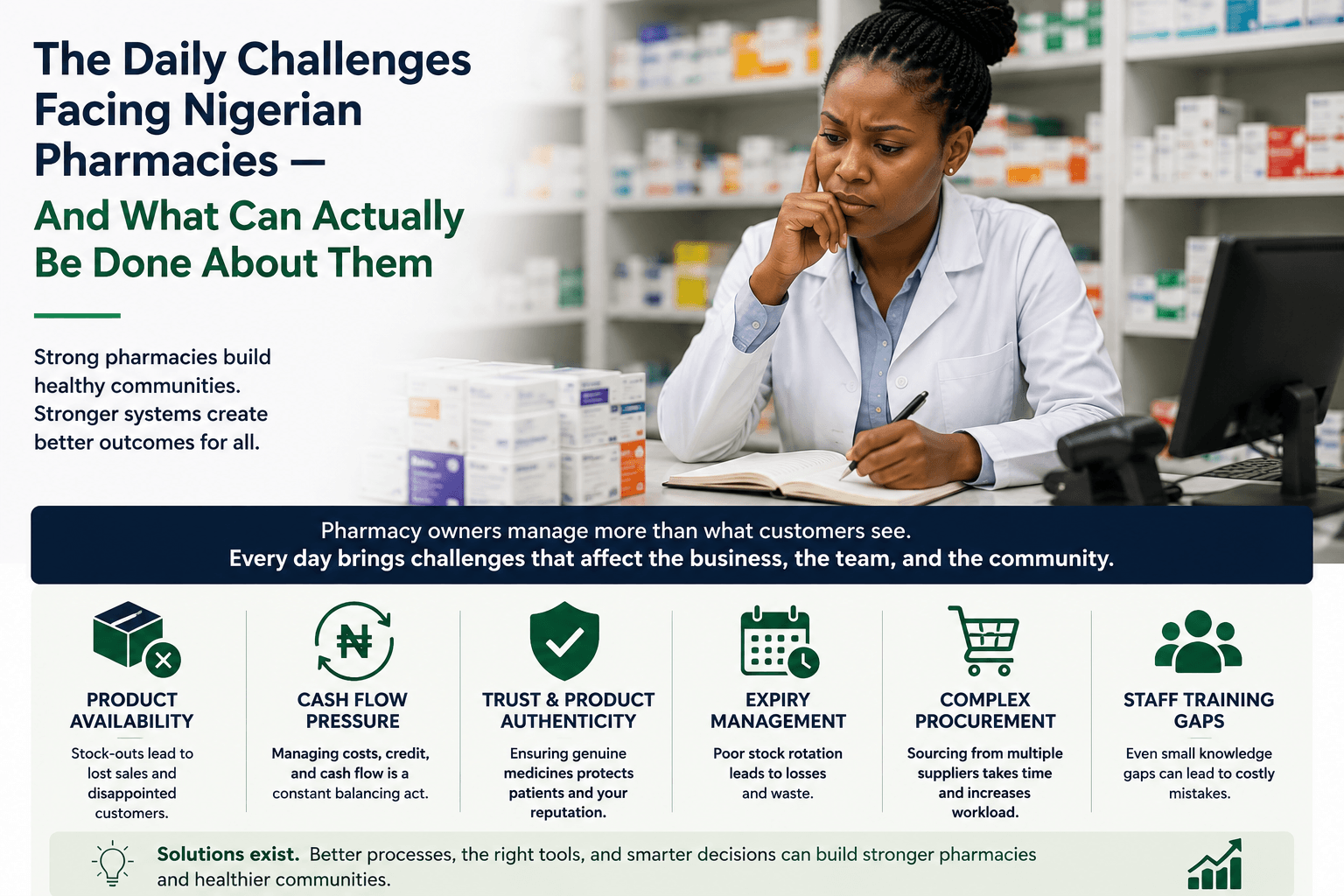
Every pharmacy owner understands the visible side of the business. The shelves. The prescriptions. The customers. The daily transactions. What is less visible is the constant balancing act happening behind the counter. Inventory must be available before patients ask for it. Suppliers must deliver when promised. Expiring products must be monitored. Cash flow must remain healthy. Regulatory requirements must be maintained. Staff must be trained. Customers must be served. When these systems work well, a pharmacy operates smoothly. When they do not, the consequences are felt immediately — not only by the business but also by the communities that depend on it. Across Nigeria, pharmacies face many of the same operational challenges regardless of their size or location. While no single solution can solve every problem, understanding these challenges is the first step toward building a stronger and more sustainable pharmacy business.
One of the most common frustrations for pharmacy owners is product availability.
A customer arrives with a prescription. The medicine is unavailable. A fast-moving product sells out unexpectedly. A supplier promises delivery but fails to fulfil the order. A distributor has stock, but at a significantly higher price than usual.
Over time, these stock-outs create more than lost sales. They affect customer confidence. Patients begin to assume they can find what they need elsewhere.
Many pharmacies attempt to solve this challenge by maintaining relationships with multiple suppliers, distributors, and wholesale markets. While this approach provides flexibility, it often increases procurement complexity and operational workload.
MSC helps pharmacies access multiple verified suppliers through a single procurement platform, reducing the need to contact multiple distributors individually.
The platform is also being developed to provide improved stock visibility, allowing pharmacies to identify available products more quickly and make procurement decisions with greater confidence.
No platform can eliminate inventory shortages caused by manufacturers, import disruptions, regulatory actions, or nationwide supply challenges.
Pharmacy owners must still maintain strong inventory planning and forecasting practices.
Many pharmacies are profitable on paper but still struggle operationally because of cash flow pressure.
Inventory must be purchased before it can be sold. Staff salaries must be paid monthly. Rent, utilities, transportation, and regulatory expenses continue regardless of sales performance.
This reality explains why supplier credit remains so important across the pharmaceutical ecosystem. For many pharmacies, credit is not simply a convenience. It is a critical part of daily operations.
MSC is building procurement infrastructure that supports more predictable purchasing and supplier access.
As the platform evolves, financing and credit-support initiatives may help qualified pharmacies improve purchasing flexibility.
No platform can replace sound financial management.
Cash flow discipline, budgeting, debt management, and inventory planning remain the responsibility of pharmacy owners and operators.
Nigeria's pharmaceutical sector has made significant progress over the years, but concerns around counterfeit, substandard, and improperly handled products remain a reality.
For pharmacy owners, the risk extends beyond financial loss. Patient safety, business reputation, and regulatory compliance are all involved. Trust is therefore not an abstract concept. It is an operational necessity.
MSC is implementing visibility features designed to increase procurement confidence, including verified supplier identification, product source visibility, NAFDAC information, batch information, expiry date visibility, consumer protection processes, and refund and return frameworks.
MSC can provide information and transparency, but pharmacy owners remain responsible for conducting due diligence and complying with all regulatory obligations.
A product does not become a problem when it expires. It becomes a problem months before expiration if inventory is not properly monitored.
Many pharmacies lose revenue annually due to poor stock rotation, inadequate monitoring, or over-purchasing slow-moving products.
MSC's planned expiry visibility features will help pharmacies make better-informed purchasing decisions before placing orders.
MSC cannot manage a pharmacy's internal inventory handling, storage procedures, or stock rotation processes.
Many pharmacies still manage procurement through a combination of phone calls, WhatsApp messages, distributor visits, notebooks, spreadsheets, and physical market trips. While these methods work, they often consume significant time and create operational inefficiencies.
MSC is focused on simplifying procurement workflows.
Features such as product search improvements, stock visibility, and one-tap reorder functionality are designed to reduce procurement effort and improve operational efficiency.
Process discipline must still come from within the pharmacy.
Technology can support efficiency, but it cannot replace operational structure.
Many procurement decisions are not made directly by pharmacy owners. They are made by attendants, front-desk staff, store managers, and support personnel. Even the best systems fail when users do not understand them.
MSC aims to provide a simple, accessible platform that can be used by both pharmacy owners and operational staff.
Employee performance, discipline, and training remain internal management responsibilities.
Technology alone will not solve every challenge facing Nigerian pharmacies.
A procurement platform cannot replace operational discipline. A marketplace cannot replace sound financial management. Inventory visibility cannot replace proper forecasting.
However, the right tools can reduce friction, improve visibility, increase trust, and simplify many of the processes that consume valuable time and resources.
The strongest pharmacies are not necessarily those with the largest inventory or the most customers. They are often the ones with the strongest operational systems.
At MSC, our goal is not simply to help pharmacies buy products. It is to support the development of a more reliable, transparent, and efficient pharmaceutical supply ecosystem.
Some challenges can be solved through technology. Others require better processes, stronger management, and continuous improvement from pharmacy owners themselves.
The future of pharmacy operations will depend on both.
The challenges facing Nigerian pharmacies are real, consistent, and shared across the industry.
But they are not insurmountable.
With the right combination of operational discipline, reliable suppliers, and digital tools built specifically for pharmaceutical commerce, pharmacies can operate with greater confidence, efficiency, and resilience.
MSC will continue sharing insights, practical guidance, and platform updates to support pharmacy businesses across Nigeria.
Stay connected for more updates and insights.
The latest industry news, interviews, technologies, and resources.
View All PostsWhy the Way Pharmacies Buy Medicines Is Changing
12th march, 2026

Why many pharmacies spend more time sourcing medicines than serving patients

13th march, 2026
Stay on top of what's moving in pharma and industrial supply across West Africa.